
Online Safety for Children: Three Warning Signs Beyond “Stranger Danger”
“Don’t talk to strangers online.”
It is familiar advice, and it still has value. Children should be cautious when people they do not know try to contact them.
But stranger danger is no longer enough as a model for online safety.
An uncomfortable request may come from a classmate, an older child, a gaming friend, a romantic partner or an adult the child already knows. The more useful lesson is therefore not simply to identify who is “good” or “bad”. It is to recognise when someone’s behaviour crosses a boundary.
Children need three practical warning signs they can use across games, social media, messaging apps and group chats:
Pressure
Secrecy
Unwanted requests

The key takeaway
Online safety for children should focus on behaviour, not only identity.
Someone may be familiar and still behave unsafely. Someone first met online is not automatically dangerous. What matters is whether the person applies pressure, demands secrecy, ignores boundaries or asks for something private or uncomfortable.
Children should know that they can pause, refuse, leave and tell a trusted adult—even if they initially replied, participated or agreed.
What the new UNICEF research found
In September 2026, UNICEF published Through Children’s Eyes: How Digital Technologies Enable Child Sexual Abuse, developed through the Disrupting Harm research project involving UNICEF, ECPAT International and INTERPOL.
The research drew on nationally representative surveys of approximately 21,000 internet-using children aged 12–17 across 21 countries. It also included in-depth interviews with 100 young people who had experienced abuse during childhood.
UNICEF estimated that almost one in five internet-using children aged 12–17 in the countries studied had experienced at least one form of technology-facilitated sexual exploitation or abuse during a one-year period.
However, the finding that may be most useful for parents and educators is not the headline prevalence figure:
In 57% of cases, the person involved was someone the child already knew.
This included peers, friends, romantic partners and family members. In 38% of cases, the child had first encountered the person online.

Nearly 60% of cases occurred through mainstream social media, while approximately 14% occurred through online games. This suggests that the issue is not confined to obscure websites or obviously suspicious spaces. Harm can develop through the same digital environments children use to play, communicate and maintain relationships.
The findings do not mean that children should distrust everyone they meet or know. They show why judging a situation only by whether the person is a stranger can leave children unprepared for other forms of unsafe conduct.
You can read the full UNICEF research page and its findings and methodology summary.
What this research does—and does not—tell us about Singapore
Singapore was not one of the 21 countries studied. The “one in five” estimate must not be interpreted as a measurement of Singapore children.
The surveys covered internet-using children aged 12–17, rather than all children or Explorer Junior’s main age group of 7–12. Data were also collected during two different periods: primarily 2020–2021 in 12 countries and 2024–2025 in another nine countries.
As with research involving sensitive experiences, some findings rely on children’s understanding, recall and willingness to disclose what happened. Underreporting may mean that not every incident was captured, but we should not use that possibility to invent a higher prevalence figure.
Children who reported these experiences were also more likely to report anxiety, self-harm and suicidal thoughts or behaviours. These associations are concerning, but the research does not by itself establish that the online experiences caused those outcomes.
These limitations matter. They do not make the findings irrelevant to Singapore, but they define how we should use them.
The report does not establish how common these experiences are among Singapore children aged 7–12. It does support teaching preventive skills earlier, in age-appropriate ways: recognising pressure and secrecy, protecting private information, refusing unwanted requests and knowing how to seek help.
Move from identifying dangerous people to recognising unsafe behaviour
Children often cannot reliably determine another person’s intentions online.
A request might begin as a joke, a game, a compliment or a sign of friendship. The person might be familiar. The interaction may not feel threatening at first.
Instead of expecting children to decide whether someone is a “bad person”, we can help them notice three more concrete signals.
1. Pressure
Pressure happens when someone tries to push a child past hesitation, discomfort or a clear “no”.
It may sound like:
“Reply now.”
“If you were really my friend, you would do it.”
“Everyone else has already done it.”
“Don’t be boring.”
“I’ll stop being your friend if you don’t.”
“You’re making me upset.”
Pressure does not always sound angry or threatening. It can be flattering, playful or emotionally manipulative. A child may be made to feel responsible for proving their friendship or protecting the other person’s feelings.
A child-friendly question is:
“Is someone trying to make you do something you do not want to do?”
Children can also learn that hesitation is enough reason to pause. They do not need to prove that a request is dangerous before stepping away.
2. Secrecy
Privacy and secrecy are not always the same.
Children deserve appropriate privacy as they grow. Families may also keep temporary surprises, such as a birthday present. A safe surprise has a clear purpose and an intended ending.
An unsafe secret is more likely to make a child feel worried, trapped or isolated. Someone might ask the child to:
Hide a conversation
Delete messages
Move to a private messaging platform
Avoid telling their parents or teacher
Keep the interaction secret indefinitely
Believe that trusted adults “would not understand”
A child-friendly question is:
“Has someone told you that an online conversation must be kept secret from the adults who care for you?”
The warning sign is not simply that a conversation is private. It is that secrecy is being used to separate the child from people who could help.
3. Unwanted requests
Children may encounter requests for:
Personal information
Photographs or videos
Private calls
Their location
Money or virtual items
Account details or passwords
Sexual conversation or content
Something else that feels confusing, embarrassing or wrong
Some requests are clearly inappropriate. Others may become uncomfortable only after repeated messages or a change in tone.
A child-friendly question is:
“Has someone asked you for something that feels private, confusing, embarrassing or wrong?”
“Unwanted” is more useful than simply “unusual”. Harmful requests can appear normal within a friendship or group. Children need permission to notice their own discomfort even when everyone else seems relaxed about what is happening.
They should also know that saying yes once does not remove their ability to say no later. A child who initially joined a conversation, sent a message or trusted someone can still withdraw, leave and ask for help.
Why children may not tell an adult
More than 40% of affected children in the UNICEF research told nobody. Fewer than 1% reported what happened to the police, a social worker or a helpline.
A common reason was not knowing where to go or whom to tell.
Children may also remain silent because they fear:
Being blamed
Losing access to their phone, game or account
Embarrassing themselves
Getting a friend into trouble
Being told they should have known better
Adults becoming angry or overreacting
Having to repeat the experience to several people
Discovering that the situation is considered more serious than they realised
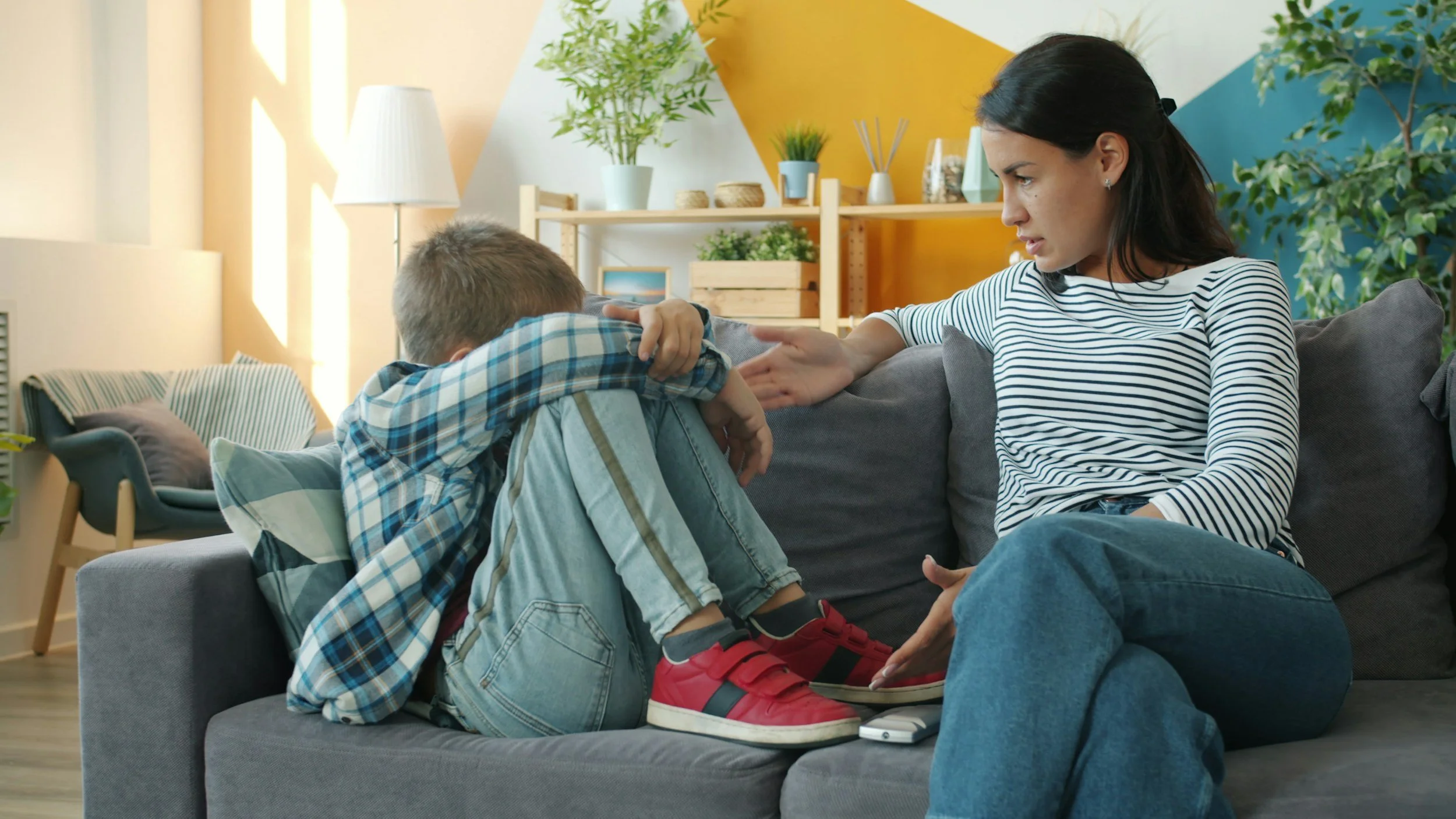
Some children may believe they cannot ask for help because they participated willingly at first.
This is why a disclosure is not the right moment for an interrogation about every choice the child made. Questions about rules and future precautions can come later. The first priority is to help the child feel safe enough to continue talking.
A promise parents can make
Parents can tell their child:
“If something uncomfortable happens online, you can tell me. I will help you first. You will not be blamed or automatically lose your device because you asked for help.”
This does not mean removing all boundaries or consequences.
It means separating two conversations:
The immediate safeguarding response
The later discussion about choices, rules and future precautions
When a child discloses something uncomfortable, the first adult response can be:
Stay calm and listen
Thank the child for telling you
Reassure them that asking for help was the right choice
Check whether there is any immediate danger or continuing contact
Preserve relevant account names, links and message details without forwarding private content unnecessarily
Use the platform’s reporting tools and seek appropriate professional or official help
Avoid repeatedly questioning the child or demanding that they retell everything immediately
A punishment-first response can unintentionally teach a child that telling the truth makes their situation worse. Firm boundaries may still be needed, but help should come first.

What schools and educators should change
An annual cyber-wellness assembly is not enough if students cannot remember what to do—or whom to approach—when something actually happens.
Schools and programme providers can make digital-safety education more practical by ensuring that:
Every child knows at least one named adult or clearly labelled reporting route
Scenarios include classmates, friends, group chats and gaming contacts—not only anonymous adult strangers
Children practise how to pause, refuse, leave, preserve relevant information and tell someone
Teachers avoid framing every incident as “the child should have known better”
Staff know the escalation procedures for coercion, image sharing, sexual harassment and threats
Lessons remain age-appropriate and avoid graphic or frightening examples
At Explorer Junior, we often use a simple sequence: notice the warning sign, think before responding, take a safe action and seek help. Children are more likely to use these skills when they have practised them through realistic situations rather than only hearing a list of rules.
The burden cannot sit entirely with children. Adults must create reporting routes that children can understand and trust.
Platforms have responsibilities too
On 31 August 2026, the European Commission designated ChatGPT as a Very Large Online Search Engine and Roblox and Reddit as Very Large Online Platforms under the European Union’s Digital Services Act.
These classifications were triggered by the services reaching at least 45 million average monthly users in the EU. The additional obligations include assessing and mitigating systemic risks, including negative effects on minors and users’ physical and mental wellbeing.
The designations do not prove that ChatGPT or Roblox is unsafe. They are regulatory classifications based on the nature, reach and potential systemic influence of the services. The requirements apply in the EU, not Singapore, although resulting audits, risk assessments or platform changes may influence services used internationally.
The wider principle is still relevant:
Families and schools should not be expected to compensate indefinitely for digital environments that are unsafe by design.
Platforms, regulators, schools and families all have different responsibilities.
For Explorer Junior’s AI programmes, this is why children use AI within a defined and facilitated learning experience. They are taught not to enter personal information, not to treat chatbot responses as unquestioned facts and to check outputs using human judgement.
Read the European Commission’s Digital Services Act announcement.
Children should not have to handle it alone
“Don’t talk to strangers” is easy to remember, but it does not prepare children for every situation they may encounter.
A stronger online-safety conversation teaches children to recognise conduct:
Is someone pressuring me?
Am I being asked to keep an unsafe secret?
Does this request feel private, confusing, embarrassing or wrong?
Children do not need to determine another person’s intentions before asking for help. They do not need to manage every situation alone.
Navigating technology with confidence does not mean always knowing the right answer. Sometimes, confidence means stopping, leaving and telling someone who can help.
For Workplaces, Schools and Community Partners
Explorer Junior works with schools, community organisations and corporate partners to help children and adults build practical digital judgement.
Our Digital Literacy workshops and parent talks can be adapted for schools, community programmes, corporate wellbeing initiatives and lunchtime learning sessions.
